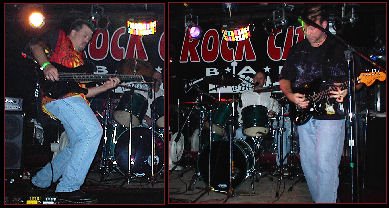
2.26.2006

CD Update... Feb. 21 and Feb. 23, 2006


(The man!! Peter Carie of The Rhythm Room studios)


All right... I'm still under the weather and I feeling a bit better and just have enough energy to write this here and tell you what is going on. I been having some sever chronic insomnia for the past two weeks and it's kicking my ass pretty dam hard right now... In the last 72 hours, starting Monday, I counted maybe six hours of sleep. That's about two hours a day, give or take... I have a very bad headache on the top of my head, chills, fever, sneezing and bronchitis... Talk about a low immune system... Well enough of the wining and here's what's going on...
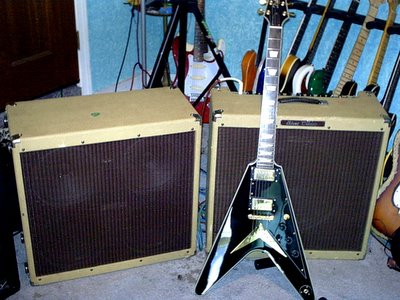

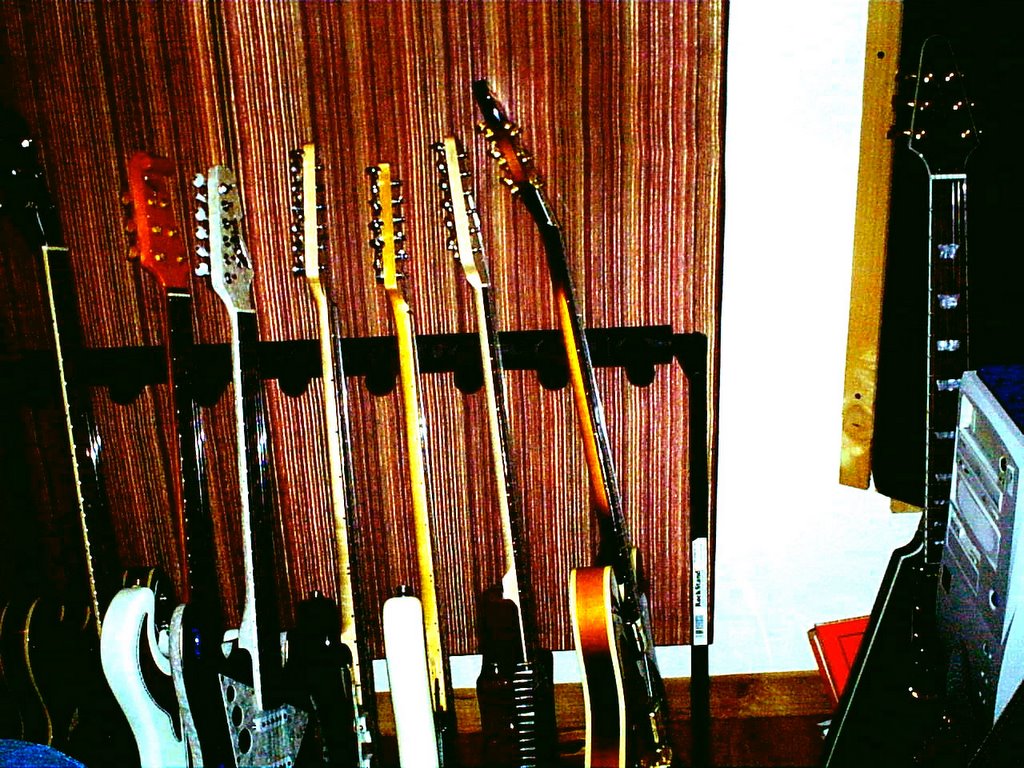
(My Dillion Flying V and Peavey Blues Classic was used one of the rhythm track on "Streets")


Feb 21: When in at around 11:am until 6:00pm and it was the first day to do lead guitar parts. I dropped off my mom at an appointment and I got lost trying to make to the studio along the way... Here I thought I knew my way in/out of San Antonio...

I felt like total shit thru out the whole Tuesday Feb. 21 day session... That was the day sickness and fatigue was creeping in...


The lead tracks that were complete Tuesday Feb. 21, 2006:

1.What I Dreamed To Do
2.Earth Blues
3.It's Not Me
4.Mary Jane


Feb. 23 10:00am - 8:30pm.... It was long and gruling but I finished all the lead guitar parts. It did feel good to play and I got in the zone pretty quickly... I do wished I had more time but I am about 85% happy with it. I had ask Peter towards the end of the day. To play me the Tuesday's session to make sure the feel was right and I was pleased what I heard.

The lead tracks done on the Feb. 23, 2006. 10:00am-8:30pm:

1.Day By Day

2.There's A Hole In My Heart

3.Live

4.Satan's Alley

5.Savvy

6.Streets
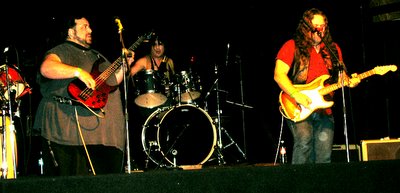

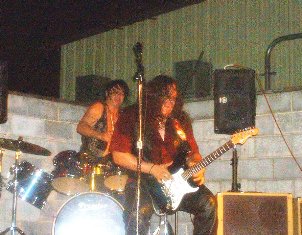
(Live at Sam's Buger Joint in Jan' 06.)


March 3rd is schedule for vocal duties...

The CD will take longer for it's released. I'm looking at maybe late March early April... JCM

Yamaha RGX-A2


MONSTER TONE MACHINE!!


Yamaha RGX -A2 is one of the guitars that I used for "Satan's Alley and "What I Dreamed To Do"... Peter and I was so impressed with it's tone and resonating sounds. I played some open chords and it shows off it's crunch and roar.

I did exactly what I wanted to do, which was, add some different sound textures and this beauty performed wonderfully... The pickups are not twangy as a single coil and it doesn't have that high output humbucker sound either. It's somewhere in between and it's very sweet and heavenly... JCM
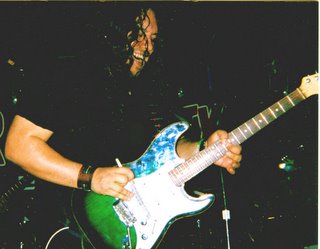
From the www.yamaha.com site:

The All New RGX A2 electric guitar is a marvel of modern technology. The proprietary A.I.R. (Alternative Internal Resonance) construction body, LED lit cylindrical diecast knobs, diecast cylindrical tuners, and Yamaha Alnico soapbar pickups make this a high tech transport for your musical creativity.

DETAILS :
Construction:
Bolt-On
Body:
Original A.I.R. (Alternative Internal Resonance)
Neck:
Maple
Fingerboard:
Rosewood
Bridge:
Yamaha Original
Pickups: 2 Yamaha Alnico Humbuckers
Controls: Graphic Pickup Selector Knob, Volume Knob
Colors: White, Aircraft Gray

2.15.2006

Feb. 11 & 12, 2006: Day two and three in the studio..

The Killing Floor's CD demands more time!!


All right here's what happen Saturday from 3:30pm - 3:00am and Sunday 6:00pm-12:00am. All rhythm tracks are done except for two "Earth Blues" and "Satan's Alley".


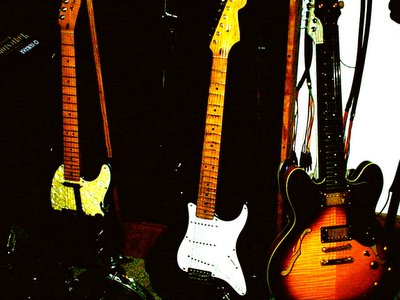
From Right to Left: American Fender Telecaster, Eric Clapton Fender "Kel-Blackie" with a light scallop fretboard and Epiphone "Dot" archtop.

The Telecaster is all over Day By Day and will be used on the solos also. The Epi is all over "It's Not Me" and was used with the Yamaha DG100A amp.


Manic Depression was done in one take just like rehearsal. The scratch rhythm with lead will stay. I figured the feel and vibe was there so why even fuck with it. You might hear some amp noise which it's cool because it's the only track that won't be so polished and was not constructed part by part.


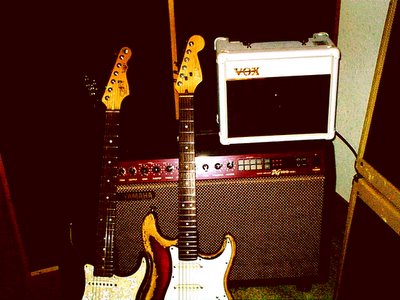
G&L S-500 "Maggie" , 40th anniversary American strat "Jeannie" and a Yamaha DG100A amp. The Yamaha DG is one of the best amp for clean. Hands down for it's amazing and unique tone. "It's Not Me" is where you'll hear this amp shine all by it's self. I haven't used the small Vox VBM1 yet but I'm planning on using it on the solo parts of "Streets".

What took time was playing rhythms to where my solos would be. Remember there were no solos to use as reference as I'm playin' along. I had to come up with a rhythm parts right there and then and fast.


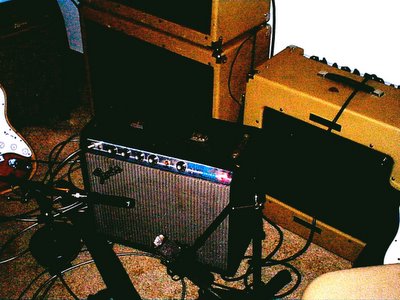
Fender Princeton is the amp that's miked up. The bottom right amp behind the Fender Princeton is a Peavey Delta Blues and I blew the 15" speaker right in the middle of Mary Jane. Peter suggested to use his Fender Princeton because the tone was closes to what I was looking for. A twang tone with lots of grit and a smooth gain distortion breakup as you cranked up the volume very loud.

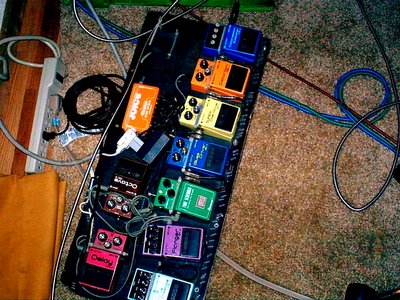
My Fender strat "Jeannie", an original "Tube Screamer TS 808"pedal, and Peter's Fender Princeton and that was it... I used this setup on the right rhythm channel of "Mary Jane"... Check out the pictures... That's Peter's pedal board by the way...


The Holy Grail of pedals is the green one. An original "Tube Sceamer TS808". SRV used theses by the way to get that heavenly boosted solo tones on his earlier albums or CDs...

The Killing Floor's CD will not sound the same as far as amp and guitar tones... There's was lots of planning and busting my back hauling lots of gear back and forth... wheww ohh shit!!...
I will go back on Feb 20th and do the remaining rhythms tracks and finish off the solo leads parts.... Till then stay tune!! JCM

2.11.2006

Day 1: Friday 6:00pm-12:00am Feb. 10, 2006

(the machines)


Here some pictures from the studio session day 1...

Eleven tracks were recorded:


track 10. "Down Down on Me" was omitted from the original track list and instead "Manic Depression" and "Earth Blues" was added. Reason for not recording "Down Down on Me"?? It' still a very new song and stills needs lots a work and mileage. Plus we were running out of time and decided to replace it was two tracks the we could rip thru very fast...

Drum and bass tracks are done and Saturday all the guitars will be recorded next. The plan on Sunday to record vocals, backing and other fills...


Friday's session went very well and one of the highlights.... Jack killing his kit on "Manic Depression". He shines on that track.... JCM
2.02.2006

The Killing Floor will be in the Studio Feb. 10-12, 2006


Alright here's what's going on... NEW CD In MARCH!! The Killing Floor will be in the studio Feb. 10-12... It will be about 20 hours in three days maybe even more days added... I will make it a point not to be an all out strat guitar recorded CD. It will have different textures, tones and sounds...

I'm taking everything but the kitchen sink and I'm going to ask if I could spend the night also and might not even shower for those three days too....lol

Amps:

Peavey Classic 50 and Peavey Blues Classic with a fithteen inch speaker, Peavey 5150 combo, a Yamaha DG 60, and a Yamaha DG 100 with 2-12 celestion green backs. I also will be cheating and using a Line 6 POD 2.0 version. I will also have access to Fender amps, maybe even Marshalls and will use those as well.


My guitars that will be used:

Strats sounds:

G&L's, Fenders, one Italia, and one Burns.

Telecaster:A USA made blue one that I haven't given a female name yet...

Heavy dual humbucker Les Paul sounds:

2 Yamaha AES

Two baritones guitars: Yamaha AES and OLP..

Other guitars:

Epiphone E335 dot, and a Yamaha E335 style with three soap bar pickups, Jerry Jones Sitar, Ibanez RT 12 string, Yamaha Dave Navarro Signature Acoutsic, a Yamaha Compass 12 string acoutsic.

Pedals:

Just whatever I'm using now on my pedal board: Dunlop Crybabe and my Yamaha Magic Stomp for texture like flange, chorus and other wierd sounds.

Again here's the order of the setlist... All the ten songs are original TKF tunes except for the extras last two... Which are Hendrix cover tunes...

1.Streets
2.Savvy
3.Mary Jane
4.What I dream to do
5.Day By Day
6.There's Hole In My Heart
7.It's Not Me
8.Live
9.Satan's Alley
10.Down, Down on Me

Extras:
11.Earth Blues
12.Manic Depression

January Stats... From: SA ROCKS BLOG

(STOP!! When you find the quest of self discovery.)


Taken from www.sarocks.blogspot.com

February 1, 2006:


Well, January was down in hits from December, but that's about right for the entertainment industry, judging from my experience in working in bars. Big dip after the holiday season, picking back up around Rodeo time in this town, so I'm not worried.

Anyhow, here are the Top 5's:

Top 5 Band Links Clicked On
SpitFire
String Theory
Drive
Rok Candy
Failsafe

Top 5 Club Links Clicked On:
Q Bar
Hooligan's
Sherlock's Pub
The White Rabbit
The Sanctuary

Top Five on the Jukebox:By Hits
Amplifyd "Sun and Moon"
Skunkweed "Wasted"
Monkey Blood "Head"
21BLACK "Take Some Time" (cover)
The Killing Floor "Voodoo Chile" (cover)

By Kilobytes:
The Killing Floor "Voodoo Chile" (cover)
Monkey Blood "Head"
21BLACK "Take Some Time" (cover)
Amplifyd "Sun and Moon"
Skunkweed "Wasted"

Close Contenders:
Desdemona "One More Tragedy"
Sexto Sol "Riverside"
Structure "Like I Should"

Review by Rowan:

Voodoo Chile and The Vampires Made Love...

I have received lots of compliments on "Voodoo Chile" and "...And Vampires Made Love" and again I'm so greatful for the love. On a sad note they will be replaced once the new material are done and finished... So if you haven't down loaded them yet do so now. By March the 15th on my birthday they will be replaced. Now if we do have more time I will maybe... This is a big maybe... Have an exclusive cover for Myspace. It all about recording this year!!!


(Do it!!... Down Load'em)

www.myspace.com/thekillingfloor

1.31.2006


TKF IN FEBRUARY
The Killing Floor's first major recording sessions begin in mid-February!

Here are the songs that will hopefully make it on time, and all on the upcoming CD, getting the production out in March, '06:


1.Streets
2.Savvy
3.Mary Jane
4.It's All I Dream
5.Day By Day
6.Live
7.Hole In My Heart (Revision of 'You're So Excited')
8.It's Not Me
9.Satan's Alley (Instrumental)
10.Down, Down On Me (New song never performed live)

1.14.2006

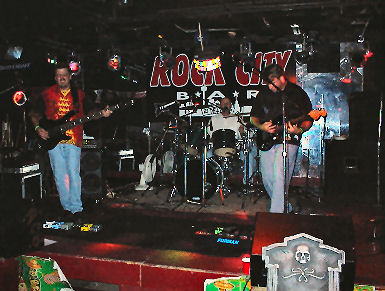
THE KILLING FLOOR @ Rock City Bar 1-14-06

We haven't done this in a while but...

Three hours of nothing but THE KILLING FLOOR!

Doors open at 9:00pm...

1.07.2006

The Problem With Music.

Just an interesting article explaining the bottom $$$ line between indie bands and major labels.

Newer and less business savvy indie bands should read this.. :)

The Problem With Music

Steve Albini

Whenever I talk to a band who are about to sign with a major label, I always end up thinking of them in a particular context. I imagine a trench, about four feet wide and five feet deep, maybe sixty yards long, filled with runny, decaying s***. I imagine these people, some of them good friends, some of them barely acquaintances, at one end of this trench. I also imagine a faceless industry lackey at the other end, holding a fountain pen and a contract waiting to be signed.

Nobody can see what’s printed on the contract. It’s too far away, and besides, the s*** stench is making everybody’s eyes water. The lackey shouts to everybody that the first one to swim the trench gets to sign the contract. Everybody dives in the trench and they struggle furiously to get to the other end. Two people arrive simultaneously and begin wrestling furiously, clawing each other and dunking each other under the s***. Eventually, one of them capitulates, and there’s only one contestant left.
He reaches for the pen, but the Lackey says, “Actually, I think you need a little more development. Swim it again, please. Backstroke.”And he does, of course.
I. A&R ScoutsEvery major label involved in the hunt for new bands now has on staff a high-profile point man, an “A&R” rep who can present a comfortable face to any prospective band. The initials stand for “Artist and Repertoire,” because historically, the A&R staff would select artists to record music that they had also selected, out of an available pool of each. This is still the case, though not openly.
These guys are universally young (about the same age as the bands being wooed), and nowadays they always have some obvious underground rock credibility flag they can wave. Lyle Preslar, former guitarist for Minor Threat, is one of them. Terry Tolkin, former NY independent booking agent and assistant manager at Touch and Go is one of them. Al Smith, former soundman at CBGB is one of them. Mike Gitter, former editor of XXX fanzine and contributor to Rip, Kerrang and other lowbrow rags is one of them. Many of the annoying turds who used to staff college radio stations are in their ranks as well.
There are several reasons A&R scouts are always young. The explanation usually copped-to is that the scout will be “hip” to the current musical “scene.” A more important reason is that the bands will intuitively trust someone they think is a peer, and who speaks fondly of the same formative rock and roll experiences. The A&R person is the first person to make contact with the band, and as such is the first person to promise them the moon. Who better to promise them the moon than an idealistic young turk who expects to be calling the shots in a few years, and who has had no previous experience with a big record company. Hell, he’s as naive as the band he’s duping. When he tells them no one will interfere in their creative process, he probably even believes it.
When he sits down with the band for the first time, over a plate of angel hair pasta, he can tell them with all sincerity that when they sign with company X, they’re really signing with him, and he’s on their side. Remember that great gig I saw you at in ’85? Didn’t we have a blast.

By now all rock bands are wise enough to be suspicious of music industry scum. There is a pervasive caricature in popular culture of a portly, middle aged ex-hipster talking a mile-a-minute, using outdated jargon and calling everybody “baby.” After meeting “their” A&R guy, the band will say to themselves and everyone else, “He’s not like a record company guy at all! He’s like one of us.” And they will be right. That’s one of the reasons he was hired. These A&R guys are not allowed to write contracts. What they do is present the band with a letter of intent, or “deal memo,” which loosely states some terms, and affirms that the band will sign with the label once a contract has been agreed on.

The spookiest thing about this harmless sounding little “memo,” is that it is, for all legal purposes, a binding document. That is, once the band sign it, they are under obligation to conclude a deal with the label. If the label presents them with a contract that the band doesn’t want to sign, all the label has to do is wait. There are a hundred other bands willing to sign the exact same contract, so the label is in a position of strength.

These letters never have any term of expiry, so the band remain bound by the deal memo until a contract is signed, no matter how long that takes. The band cannot sign to another label or even put out its own material unless they are released from their agreement, which never happens. Make no mistake about it: once a band has signed a letter of intent, they will either eventually sign a contract that suits the label or they will be destroyed.

One of my favorite bands was held hostage for the better part of two years by a slick young “He’s not like a label guy at all,” A&R rep, on the basis of such a deal memo. He had failed to come through on any of his promises (something he did with similar effect to another well-known band), and so the band wanted out.
Another label expressed interest, but when the A&R man was asked to release the band, he said he would need money or points, or possibly both, before he would consider it.The new label was afraid the price would be too dear, and they said no thanks. On the cusp of making their signature album, an excellent band, humiliated, broke up from the stress and the many months of inactivity.

II. What I hate about recording

1. Producers and engineers who use meaningless words to make their clients think they know what’s going on. Words like “Punchy,” “Warm,” “Groove,” “Vibe,” “Feel.” Especially “Punchy” and “Warm.” Every time I hear those words, I want to throttle somebody.

2: Producers who aren’t also engineers, and as such, don’t have the slightest f****** idea what they’re doing in a studio, besides talking all the time. Historically, the progression of effort required to become a producer went like this: Go to college, get an EE degree. Get a job as an assistant at a studio. Eventually become a second engineer. Learn the job and become an engineer. Do that for a few years, then you can try your hand at producing. Now, all that’s required to be a full-fledged “producer” is the gall it takes to claim to be one.

Calling people like Don Fleming, Al Jourgensen, Lee Ranaldo or Jerry Harrison “producers” in the traditional sense is akin to calling Bernie a “shortstop” because he watched the whole playoffs this year.The term has taken on perjorative qualities in some circles. Engineers tell jokes about producers the way people back in Montana tell jokes about North Dakotans. (How many producers does it take to change a light bulb? —Hmmm. I don’t know. What do you think? Why did the producer cross the road? —Because that’s the way the Beatles did it, man.) That’s why few self-respecting engineers will allow themselves to be called “producers.”The minimum skills required to do an adequate job recording an album are:-

Working knowledge of all the microphones at hand and their properties and uses. I mean something beyond knowing that you can drop an SM57 without breaking it.-

Experience with every piece of equipment which might be of use and every function it may provide. This means more than knowing what echo sounds like. Which equalizer has the least phase shift in neighbor bands? Which console has more headroom? Which mastering deck has the cleanest output electronics?-

Experience with the style of music at hand, to know when obvious blunders are occurring.- Ability to tune and maintain all the required instruments and electronics, so as to insure that everything is in proper working order. This means more than plugging a guitar into a tuner. How should the drums be tuned to simulate a rising note on the decay? A falling note? A consonant note? Can a bassoon play a concert E-flat in key with a piano tuned to a reference A of 440 Hz?

What percentage of varispeed is necessary to make a whole-tone pitch change? What degree of overbias gives you the most headroom at lOKhz? What reference fluxivity gives you the lowest self-noise from biased, unrecorded tape? Which tape manufacturer closes every year in July, causing shortages of tape globally? What can be done for a shedding master tape? A sticky one?-
Knowledge of electronic circuits to an extent that will allow selection of appropriate signal paths. This means more than knowing the difference between a delay line and an equalizer. Which has more headroom, a discrete class A microphone preamp with a transformer output or a differential circuit built with monolithics? Where is the best place in an unbalanced line to attenuate the signal? If you short the cold leg of a differential input to ground, what happens to the signal level? Which gain control device has the least distortion, a VCA, a printed plastic pot, a photoresistor or a wire-wound stepped attenuator? Will putting an unbalanced line on a half-normalled jack unbalance the normal signal path? Will a transformer splitter load the input to a device parallel to it? Which will have less RF noise, a shielded unbalanced line or a balanced line with a floated shield?-

An aesthetic that is well-rooted and compatible with the music, and- The good taste to know when to exercise it.

3. Trendy electronics and other flashy s*** that nobody really needs.

Five years ago, everything everywhere was being done with discrete samples. No actual drumming allowed on most records. Samples only. The next trend was Pultec Equalizers. Everything had to be run through Pultec EQs.

Then vintage microphones were all the rage (but only Neumanns, the most annoyingly whiny microphone line ever made). The current trendy thing is compression. Compression by the ton, especially if it comes from a tube limiter. Wow. It doesn’t matter how awful the recording is, as long as it goes through a tube limiter, somebody will claim it sounds “warm,” or maybe even “punchy.” They might even compare it to the Beatles. I want to find the guy that invented compression and tear his liver out. I hate it. It makes everything sound like a beer commercial.

4. DAT machines.

They sound like s*** and every crappy studio has one now because they’re so cheap. Because the crappy engineers that inhabit crappy studios are too thick to learn how to align and maintain analog mastering decks, they’re all using DAT machines exclusively. DAT tapes deteriorate over time, and when they do, the information on them is lost forever. I have personally seen tapes go irretrievably bad in less than a month. Using them for final masters is almost fraudulently irresponsible.Tape machines ought to be big and cumbersome and difficult to use, if only to keep the riff-raff out. DAT machines make it possible for morons to make a living, and do damage to the music we all have to listen to.

5. Trying to sound like the Beatles.

Every record I hear these days has incredibly loud, compressed vocals, and a quiet little murmur of a rock band in the background. The excuse given by producers for inflicting such an imbalance on a rock band is that it makes the record sound more like the Beatles. Yeah, right. f***’s sake, Thurston Moore is not Paul McCartney, and nobody on earth, not with unlimited time and resources, could make the Smashing Pumpkins sound like the Beatles. Trying just makes them seem even dumber. Why can’t people try to sound like the Smashchords or Metal Urbain or Third World War for a change?III.

There’s This BandThere’s this band. They’re pretty ordinary, but they’re also pretty good, so they’ve attracted some attention. They’re signed to a moderate-sized “independent” label owned by a distribution company, and they have another two albums owed to the label.They’re a little ambitious. They’d like to get signed by a major label so they can have some security —you know, get some good equipment, tour in a proper tour bus —nothing fancy, just a little reward for all the hard work.To that end, they got a manager. He knows some of the label guys, and he can shop their next project to all the right people. He takes his cut, sure, but it’s only 15Àand if he can get them signed then it’s money well spent. Anyway, it doesn’t cost them anything if it doesn’t work. 15f nothing isn’t much!

One day an A&R scout calls them, says he’s “been following them for a while now,” and when their manager mentioned them to him, it just “clicked.” Would they like to meet with him about the possibility of working out a deal with his label? Wow. Big Break time.They meet the guy, and y’know what —he’s not what they expected from a label guy. He’s young and dresses pretty much like the band does. He knows all their favorite bands. He’s like one of them. He tells them he wants to go to bat for them, to try to get them everything they want. He says anything is possible with the right attitude. They conclude the evening by taking home a copy of a deal memo they wrote out and signed on the spot.

The A&R guy was full of great ideas, even talked about using a name producer. Butch Vig is out of the question —he wants 100 g’s and three points, but they can get Don Fleming for $30,000 plus three points. Even that’s a little steep, so maybe they’ll go with that guy who used to be in David Letterman’s band. He only wants three points. Or they can have just anybody record it (like Warton Tiers, maybe —cost you 5 or 10 grand) and have Andy Wallace remix it for 4 grand a track plus 2 points. It was a lot to think about.Well, they like this guy and they trust him. Besides, they already signed the deal memo. He must have been serious about wanting them to sign. They break the news to their current label, and the label manager says he wants them to succeed, so they have his blessing. He will need to be compensated, of course, for the remaining albums left on their contract, but he’ll work it out with the label himself. Sub Pop made millions from selling off Nirvana, and Twin Tone hasn’t done bad either: 50 grand for the Babes and 60 grand for the Poster Children —without having to sell a single additional record.

It’ll be something modest. The new label doesn’t mind, so long as it’s recoupable out of royalties.Well, they get the final contract, and it’s not quite what they expected. They figure it’s better to be safe than sorry and they turn it over to a lawyer —one who says he’s experienced in entertainment law —and he hammers out a few bugs. They’re still not sure about it, but the lawyer says he’s seen a lot of contracts, and theirs is pretty good. They’ll be getting a great royalty: 13less a 10 ackaging deduction). Wasn’t it Buffalo Tom that were only getting 12ess 10? Whatever.The old label only wants 50 grand, and no points. Hell, Sub Pop got 3 points when they let Nirvana go. They’re signed for four years, with options on each year, for a total of over a million dollars! That’s a lot of money in any man’s english. The first year’s advance alone is $250,000. Just think about it, a quarter-million, just for being in a rock band!Their manager thinks it’s a great deal, especially the large advance. Besides, he knows a publishing company that will take the band on if they get signed, and even give them an advance of 20 grand, so they’ll be making that money too. The manager says publishing is pretty mysterious, and nobody really knows where all the money comes from, but the lawyer can look that contract over too. Hell, it’s free money.Their booking agent is excited about the band signing to a major. He says they can maybe average $1,000 or $2,000 a night from now on. That’s enough to justify a five week tour, and with tour support, they can use a proper crew, buy some good equipment and even get a tour bus! Buses are pretty expensive, but if you figure in the price of a hotel room for everybody in the band and crew, they’re actually about the same cost. Some bands (like Therapy? and Sloan and Stereolab) use buses on their tours even when they’re getting paid only a couple hundred bucks a night, and this tour should earn at least a grand or two every night. It’ll be worth it. The band will be more comfortable and will play better.The agent says a band on a major label can get a merchandising company to pay them an advance on t-shirt sales! Ridiculous! There’s a gold mine here! The lawyer should look over the merchandising contract, just to be safe.They get drunk at the signing party. Polaroids are taken and everybody looks thrilled. The label picked them up in a limo.
They decided to go with the producer who used to be in Letterman’s band. He had these technicians come in and tune the drums for them and tweak their amps and guitars. He had a guy bring in a slew of expensive old “vintage” microphones. Boy, were they “warm.” He even had a guy come in and check the phase of all the equipment in the control room! Boy, was he professional. He used a bunch of equipment on them and by the end of it, they all agreed that it sounded very “punchy,” yet “warm.”All that hard work paid off. With the help of a video, the album went like hotcakes! They sold a quarter million copies!Here is the math that will explain just how fucked they are:

These figures are representative of amounts that appear in record contracts daily. There’s no need to skew the figures to make the scenario look bad, since real-life examples more than abound.
Income is underlined, expenses are not.

Advance:$250,000
Manager’s cut: $37,500
Legal fees: $10,000
Recording Budget: $150,000
Producer’s advance: $50,000
Studio fee: $52,500
Drum, Amp, Mic and Phase “Doctors”: $3,000
Recording tape: $8,000
Equipment rental: $5,000
Cartage and Transportation: $5,000
Lodgings while in studio: $10,000
Catering: $3,000
Mastering: $10,000
Tape copies, reference CD’s, shipping tapes, misc expenses: $2,000
Video budget: $30,000
Cameras: $8,000
Crew: $5,000
Processing and transfers: $3,000
Offline: $2,000
Online editing: $3,000
Catering: $1,000
Stage and construction: $3,000
Copies, couriers, transportation: $2,000
Director’s fee: $3,000
Album Artwork: $5,000
Promotional photo shoot and duplication: $2,000
Band fund: $15,000
New fancy professional drum kit: $5,000
New fancy professional guitars (2): $3,000
New fancy professional guitar amp rigs (2): $4,000
New fancy potato-shaped bass guitar: $1,000
New fancy rack of lights bass amp: $1,000
Rehearsal space rental: $500
Big blowout party for their friends: $500
Tour expense (5 weeks): $50,875
Bus: $25,000
Crew (3): $7,500
Food and per diems: $7,875
Fuel: $3,000
Consumable supplies: $3,500
Wardrobe: $1,000
Promotion: $3,000
Tour gross income: $50,000
Agent’s cut: $7,500
Manager’s cut: $7,500
Merchandising advance: $20,000
Manager’s cut: $3,000
Lawyer’s fee: $1,000
Publishing advance: $20,000
Manager’s cut: $3,000
Lawyer’s fee: $1,000
Record sales: 250,000 @ $12 = $3,000,000 gross retail revenue Royalty (13f 90f retail): $351,000
less advance: $250,000
Producer’s points: (3ess $50,000 advance) $40,000
Promotional budget: $25,000
Recoupable buyout from previous label: $50,000
Net royalty: (-$14,000)
Record company income: Record wholesale price $6.50 x 250,000 = $1,625,000 gross income Artist Royalties: $351,000
Deficit from royalties: $14,000
Manufacturing, packaging and distribution @ $2.20 per record: $550,000
Gross profit: $710,000

THE BALANCE SHEET

This is how much each player got paid at the end of the game.
Record company: $710,000
Producer: $90,000
Manager: $51,000
Studio: $52,500
Previous label: $50,000
Agent: $7,500
Lawyer: $12,000

Band member net income each: $4,031.25

The band is now 1/4 of the way through its contract, has made the music industry more than 3 million dollars richer, but is in the hole $14,000 on royalties. The band members have each earned about 1/3 as much as they would working at a 7-11, but they got to ride in a tour bus for a month.

The next album will be about the same, except that the record company will insist they spend more time and money on it. Since the previous one never “recouped,” the band will have no leverage, and will oblige.The next tour will be about the same, except the merchandising advance will have already been paid, and the band, strangely enough, won’t have earned any royalties from their t-shirts yet. Maybe the t-shirt guys have figured out how to count money like record company guys.

Some of your friends are probably already this fucked.

Rabindranath Tagore

Rabindranath Tagore

"Let me not pray to be sheltered from dangers, but to be fearless in facing them.
Let me not beg for the stilling of my pain, but for the heart to conquer it.
Let me not look for allies on life's battlefield, but to my own strength.
Let me not crave in anxious fear to be saved, but for the patience to win my freedom.
Grant me that I may not be a coward, feeling your mercy in my success alone;
but let me find the grasp of your hand in my failure."
Fruit-Gathering

The Duende

The Duende: Theory and Divertissement
Federico Garcia Lorca
Oil Painting by Serrano, 1935


Composed and delivered by Lorca during his stay in Havana en route from the United States; subsequently repeated in Buenos Aires for the Sociedad Amigos del Arte (1934).
Whoever inhabits that bull's hide stretched between the Jucar, the Gaudelete, the Sil or the Pisuerga - no need to mention the streams joining those lion-coloured waves churned up by the Plata - has heard it said with a certain frequency: "Now that has real duende !" It was in this spirit that Manuel Torres, the great artist of the Andalusian people, once remarked to a singer: "You have a voice, you know all the styles, but you'll never bring it off because you have no duende."

In all Andalusia, from the rock of Jaen to the shell of Cádiz, people constantly speak of the duende and find it in everything that springs out of energetic instinct. That marvelous singer, "El Librijano," originator of the Debla, observed, "Whenever I am singing with duende, no one can come up to me"; and one day the old gypsy dancer, "La Malena," exclaimed while listening to Brailowski play a fragment of Bach: "Olé! That has duende !"- and remained bored by Gluck and Brahms and Darius Milhaud. And Manuel Torres, to my mind a man of exemplary blood culture, once uttered this splendid phrase while listening to Falla himself play his "Nocturno del Generalife": "Whatever has black sounds has duende." There is no greater truth.

These black sounds are the mystery, the roots that probe through the mire that we all know of, and do not understand, but which furnishes us with whatever is sustaining in art. Black sounds: so said the celebrated Spaniard, thereby concurring with Goethe, who, in effect, defined the duende when he said, speaking of Paganini: "A mysterious power that all may feel and no philosophy can explain."

The duende, then, is a power and not a construct, is a struggle and not a concept. I have heard an old guitarist, a true virtuoso, remark, "The duende is not in the throat, the duende comes up from inside, up from the very soles of the feet." That is to say, it is not a question of aptitude, but of a true and viable style - of blood, in other words; of what is oldest in culture: of creation made act.

This "mysterious power that all may feel and no philosophy can explain," is, in sum, the earth-force, the same duende that fired the heart of Nietzsche, who sought it in its external forms on the Rialto Bridge, or in the music of Bizet, without ever finding it, or understanding that the duende he pursued had rebounded from the mystery-minded Greeks to the Dancers of Cádiz or the gored, Dionysian cry of Silverio's siguiriya.

So much for the duende; but I would not have you confuse the duende with the theological demon of doubt at whom Luther, on a Bacchic impulse, hurled an inkwell in Nuremberg, or with the Catholic devil, destructive, but short on intelligence, who disguised himself as a bitch to enter the convents, or with the talking monkey that Cervantes' mountebank carried in the comedy about jealousy and the forests of Andalusia.

No. The duende that I speak of, shadowy, palpitating, is a descendant of that benignest demon of Socrates, he of marble and salt, who scratched the master angrily the day he drank the hemlock; and of that melancholy imp of Descartes, little as an unripe almond, who, glutted with circles and lines, went out on the canals to hear the drunken sailors singing.

Any man - any artist, as Nietzsche would say - climbs the stairway in the tower of his perfection at the cost of a struggle with a duende - not with an angel, as some have maintained, or with his muse. This fundamental distinction must be kept in mind if the root of a work of art is to be grasped.

The angel guides and endows, like Saint Raphael, or prohibits and avoids like Saint Michael, or foretells, like Saint Gabriel.

The Angel dazzles; but he flies over men's heads and remains in mid-air, shedding his grace; and the man, without any effort whatever, realizes his work, or his fellow-feeling, or his dance. The angel on the road to Damascus, and he who entered the crevice of the little balcony of Assisi, or that other angel who followed in the footsteps of Heinrich Suso, commanded - and there was no resisting his radiance, for he waved his wings of steel in an atmosphere of predestination.

The Muse dictates and, in certain cases, prompts. There is relatively little she can do, for she keeps aloof and is so full of lassitude (I have seen her twice) that I myself have had to put half a heart of marble in her. The Poets of the Muse hear voices and do not know where they come from; but surely they are from the Muse, who encourages and at times devours them entirely. Such, for example, was the case of Apollinaire, that great poet ravaged by the horrible Muse with whom the divinely angelic Rousseau painted him. The Muse arouses the intellect, bearing landscapes of columns and the false taste of laurel; but intellect is oftentimes the foe of poetry because it imitates too much, it elevates the poet to a throne of acute angles and makes him forget that in time the ants can devour him, too, or that a great arsenical locust can fall on his head, against which the Muses who live inside monocles or the lukewarm lacquer roses of insignificant salons, are helpless.

Angel and Muse approach from without; the Angel sheds light and the Muse gives form (Hesiod learned of them). Gold leaf or chiton-folds: the poet finds his models in his laurel coppice. But the Duende, on the other hand, must come to life in the nethermost recesses of the blood.
And repel the Angel, too - kick out the Muse and conquer his awe of the fragrance of violets that breathe from the poetry of the eighteenth century, or of the great telescope in whose lenses the Muse dozes off, sick of limits.

The true struggle is with the Duende.

The paths leading to God are well known, from the barbaric way of the hermit, to the subtler modes of the mystic. With a tower, then, like Saint Theresa, or with three roads, like St. John of the Cross. And even if we must cry out in Isaiah's voice: "Truly, thou art the hidden God!" at the end at last, God sends to each seeker his first fiery thorns.

To seek out the Duende, however, neither map nor discipline is required. Enough to know that he kindles the blood like an irritant, that he exhausts, that he repulses, all the bland, geometrical assurances, that he smashes the styles; that he makes of a Goya, master of the grays, the silvers, the roses of the great English painters, a man painting with his knees and his fists in bituminous blacks; that he bares a Mosen Cinto Verdaguer to the cold of the Pyrenees or induces a Jorge Manrique to sweat out his death on the crags of Ocaña, or invests the delicate body of Rimbaud in the green domino of the saltimbanque, or fixes the dead fish-eyes on the Comte de Lautréamont in the early hours of the boulevard.

The great artists of southern Spain, both gypsies and flamenco, whether singing or dancing or playing their instruments, know that no emotion is possible without the mediation of the Duende. They may hoodwink the people, they may give the illusion of duende without really having it, just as writers and painters and literary fashion-mongers without duende cheat you daily; but it needs only a little care and the will to resist one's own indifference, to discover the imposture and put it and its crude artifice to flight.

Once the Andalusian singer, Pastora Pavon, "The Girl with the Combs," a sombre Hispanic genius whose capacity for fantasy equals Goya's or Raphael el Gallo's, was singing in a little tavern in Cádiz. She sparred with her voice - now shadowy, now like molten tin, now covered with moss; she tangled her voice in her long hair or drenched it in sherry or lost it in the darkest and furthermost bramble bushes. But nothing happened - useless, all of it! The hearers remained silent.

There stood Ignacio Espeleta, handsome as a Roman turtle, who was asked once why he never worked, and replied with a smile worthy of Argantonio: "How am I to work if I come from Cádiz?"

There, too, stood Héloise, the fiery aristocrat, whore of Seville, direct descendant of Soledad Vargas, who in the thirties refused to marry a Rothschild because he was not of equal blood. There were the Floridas, whom some people call butchers, but who are really millennial priests sacrificing bulls constantly to Geryon; and in a corner stood that imposing breeder of bulls, Don Pablo Murabe, with the air of a Cretan mask. Pastora Pavon finished singing in the midst of total silence. There was only a little man, one of those dancing mannikins who leap suddenly out of brandy bottles, who observed sarcastically in a very low voice: "Viva Paris!" As if to say: We are not interested in aptitude or techniques or virtuosity here. We are interested in something else.

Then the "Girl with the Combs" got up like a woman possessed, her face blasted like a medieval weeper, tossed off a great glass of Cazalla at a single draught, like a potion of fire, and settled down to singing - without a voice, without breath, without nuance, throat aflame - but with duende ! She had contrived to annihilate all that was nonessential in song and make way for an angry and incandescent Duende, friend of sand-laden winds, so that everyone listening tore at his clothing almost in the same rhythm with which the West Indian negroes in their rites rend away their clothes, huddled in heaps before the image of Saint Barbara.

The "Girl with the Combs" had to mangle her voice because she knew there were discriminating folk about who asked not for form, but for the marrow of form - pure music spare enough to keep itself in the air. She had to deny her faculties and her security; that is to say, to turn out her Muse and keep vulnerable, so that her Duende might come and vouchsafe the hand-to-hand struggle. And then how she sang! Her voice feinted no longer; it jetted up like blood, ennobled by sorrow and sincerity, it opened up like ten fingers of a hand around the nailed feet of a Christ by Juan de Juni - tempestuous!

The arrival of the Duende always presupposes a radical change in all the forms as they existed on the old plane. It gives a sense of refreshment unknown until then, together with that quality of the just-opening rose, of the miraculous, which comes and instils an almost religious transport.

In all Arabian music, in the dances, songs, elegies of Arabia, the coming of the Duende is greeted by fervent outcries of Allah! Allah! God! God!, so close to the Olé" Olé! of our bull rings that who is to say they are not actually the same; and in all the songs of southern Spain the appearance of the Duende is followed by heartfelt exclamations of God alive! - profound, human tender, the cry of communion with God through the medium of the five senses and the grace of the Duende that stirs the voice and the body of the dancer - a flight from this world, both real and poetic, pure as Pedro de Roja's over the seven gardens (that most curious poet of the seventeenth century), or Juan Calimacho's on the tremulous ladder of tears.

Naturally, when flight is achieved, all feel its effects: the initiate coming to see at last how style triumphs over inferior matter, and the unenlightened, through the I-don't-know-what of an authentic emotion. Some years ago, in a dancing contest at Jerez de la Frontera, an old lady of eighty, competing against beautiful women and young girls with waists as supple as water, carried off the prize merely by the act of raising her arms, throwing back her head, and stamping the little platform with a blow of her feet; but in the conclave of muses and angels foregathered there - beauties of form and beauties of smile - the dying duende triumphed as it had to, trailing the rusted knife blades of its wings along the ground.

All the arts are capable of duende, but it naturally achieves its widest play in the fields of music, dance and the spoken poem, since those require a living presence to interpret them, because they are forms which grow and decline perpetually and raise their contours on the precise present.

Often the Duende of the musician passes over into the Duende of the interpreter, and at other times, when the musician and poet are not matched, the Duende of the interpreter - this is interesting - creates a new marvel that retains the appearance - and the appearance only - of the originating form. Such was the case with the duende-ridden Duse who deliberately sought out failures in order to turn them into triumphs, thanks to her capacity for invention; or with Paganini who, as Goethe explained, could make one hear profoundest melody in out-and-out vulgarity; or with a delectable young lady from the port of Santa María whom I saw singing and dancing the horrendous Italian ditty, "O Marie!" with such rhythms, such pauses, and such conviction that she transformed an Italian geegaw into a hard serpent of raised gold. What happened, in effect, was that each in his own way found something new, something never before encountered, which put lifeblood and art into bodies void of expression.
In every country, death comes as a finality. It comes, and the curtain comes down. But not in Spain! In Spain the curtain goes up. Many people live out their lives between walls until the day they die and are brought out into the sun. In Spain, the dead are more alive than the dead of any other country of the world: their profile wounds like the edge of a barbers razor. The quip about death and the silent contemplation of it are familiar to the Spanish. From the "Dream of the Skulls" of Quevedo, to the "Putrescent Bishop" of Valdés Leal; from La Marbella of the seventeenth century who, dying in childbirth on the highway, says:

The blood of my entrailsCovers the horse.And the horse's hoovesStrike fire from the pitch
to a recent young man from Salamanca, killed by a bull who exclaimed:

My friends, I am dying.My friends, it goes badly.I've three handkerchiefs inside me,And this I apply now makes four.

there is a balustrade of flowering nitre where hordes peer out, contemplating death, with verses from Jeremiah for the grimmer side or sweet-smelling cypress for the more lyrical - but in any case, a country where all that is most important has its final metallic valuation in death.
The knife and the cart wheel and the razor and the singing beard-points of the shepherds, the shorn moon and the fly, the damp lockers, the ruins and the lace-covered saints, the quicklime and the cutting line of eaves and balconies: in Spain, all bear little grass-blades of death, allusions and voices perceptible to the spiritually alert, that call to our memory with the corpse-cold air of our own passing. It is no accident that all Spanish art is bound to our soil, so full of thistles and definitive stone; the lamentations of Pleberio or the dances of the master Josef Maria de Valdivielso are not isolated instances, nor is it by chance that from all the balladry of Europe the Spanish inamorata disengages herself in this fashion:

"If you are my fine friend,Tell me - why won't you look at me?"
"The eyes with which I look at you
I gave up to the shadow.""If you are my fine friendTell me - why don't you kiss me?"
"The lips with which I kissed you
I gave up to the clay.""If you are my fine friendTell me - why won't you embrace me?"
"The arms that embrace you
I have covered up with worms."

Nor is it strange to find that in the dawn of our lyricism, the following note is sounded:
Inside the gardenI shall surely die.Inside the rosebushThey will kill me.Mother, Mother, I went outGathering roses,But surely death will find meIn the Garden.Mother, Mother, I went outCutting roses,But surely death will find meIn the rosebush.Inside the gardenI shall surely die.In the rosebushThey will kill me.

Those heads frozen by the moon that Zurbarán painted, the butter-yellows and the lightening-yellows of El Greco, the narrative of Father Sigüenza, all the work of Goya, the presbytery of the Church of the Escorial, all polychrome sculpture, the crypt of the ducal house of Osuna, the death with the guitar in the chapel of the Benavente in Medina de Río Seco - all equal, on the plane of cultivated art, the pilgrimages of San Andrés de Teixido where the dead have their place in the procession; they are one with the songs for the dead that the women of Asturias intone with flame-filled lamps in the November night, one with the song and dance of the Sibyl in the cathedrals of Mallorca and Toledo, with the obscure "In Recort" of Tortosa, and the innumerable rites of Good Friday that, with the arcane fiesta of the Bulls, epitomize the popular triumph of Spanish death. In all the world, Mexico alone can go hand-in-hand with my country.
When the Muse sees death on the way, she closes the door, or raises a plinth, or promenades an urn and inscribes an epitaph with a waxen hand, but in time she tears down her laurels again in a silence that wavers between two breezes. Under the truncated arch of the Ode, she joins with funereal meaning the exact flowers that the Italians of the fifteenth century depicted, with the identical cock of Lucretius, to frighten off an unforeseen darkness.

When the Angel sees death on the way, he flies in slow circles and weaves with tears of narcissus and ice the elegy we see trembling in the hands of Keats and Villasandino and Herrera and Becquer and Juan Ramón Jiménez. But imagine the terror of the Angel, should it feel a spider - even the tiniest - on its tender and roseate flesh!

The Duende, on the other hand, will not approach at all if he does not see the possibility of death, if he is not convinced he will circle death's house, if there is not every assurance he can rustle the branches borne aloft by us all, that neither have, nor may ever have, the power to console.

With idea, with sound, or with gesture, the Duende chooses the brim of the well for his open struggle with the creator. Angel and Muse escape in the violin or in musical measure, but the Duende draws blood, and in the healing of the wound that never quite closes, all that is unprecedented and invented in a man's work has its origin.

The magical virtue of poetry lies in the fact that it is always empowered with duende to baptize in dark water all those who behold it, because with duende, loving and understanding are simpler, there is always the certainty of being loved and being understood; and this struggle for expression and for the communication of expression acquires at times, in poetry, finite characters.

Recall the case of that paragon of the flamenco and daemonic way, Saint Teresa - flamenca not for her prowess in stopping an angry bull with three significant passes - though she did so - nor for her presumption in esteeming herself beautiful in the presence of Fray Juan de Miseria, nor for slapping the face of a papal nuncio; but rather for the simple circumstance that she was one of the rare ones whose Duende (not her Angel - the Angels never attack) pierced her with an arrow, hoping thereby to destroy her for having deprived him of his ultimate secret: the subtle bridge that links the five senses with the very center, the living flesh, living cloud, living sea, of Love emancipated from Time.

Most redoubtable conqueress of the Duende - and how utterly unlike the case of Philip of Austria who, longing to discover the Muse and the Angel in theology, found himself imprisoned by the Duende of cold ardors in that masterwork of the Escorial, where geometry abuts with a dream and the Duende wears the mask of the Muse for the eternal chastisement of the great king.

We have said that the Duende loves ledges and wounds, that he enters only those areas where form dissolves in a passion transcending any of its visible expressions.

In Spain (as in all Oriental countries where dance is a form of religious expression) the Duende has unlimited play in the bodies of the dancers of Cádiz, eulogized by Martial, in the breasts of the singers, eulogized by Juvenal, and in all the liturgy of the bulls - that authentic religious drama where, in the manner of the Mass, adoration and sacrifice are rendered a God.
It would seem that all the duende of the classical world is crowded into this matchless festival, epitomizing the culture and the noble sensibility of a people who discover in man his greatest rages, his greatest melancholies, his greatest lamentations. No one, I think, is amused by the dances or the bulls in Spain; the Duende has taken it on himself to make them suffer through the medium of drama, in living forms, and prepares the ladders for flight from encompassing reality.

The Duende works on the body of the dancer like the wind works on sand. With magical force, it converts a young girl into a lunar paralytic; or fills with adolescent blushes a ragged old man begging handouts in the wineshops; or suddenly discovers the smell of nocturnal ports in a head of hair, and moment for moment, works on the arms with an expressiveness which is the mother of the dance of all ages.

But it is impossible for him ever to repeat himself - this is interesting and must be underscored. The Duende never repeats himself, any more than the forms of the sea repeat themselves in a storm.

In the bullfight, the Duende achieves his most impressive advantage, for he must fight then with death who can destroy him, on one hand, and with geometry, with measure, the fundamental basis of the bullfight, on the other.

The Bull has his orbit, and the bullfighter has his, and between orbit and orbit is the point of risk where falls the vertex of the terrible byplay.

It is possible to hold a Muse with a muletta and an Angel with banderillas, and pass for a good bullfighter; but for the faena de capa, with the bull still unscarred by a wound, the help of the Duende is necessary at the moment of the kill, to drive home the blow of artistic truth.
The bullfighter who moves the public to terror in the plaza by his audacity does not fight the bull - that would be ludicrous in such a case - but, within the reach of each man, puts his life at stake; on the contrary, the fighter bitten by the Duende gives a lesson in Pythagorian music and induces all to forget how he constantly hurls his heart against the horns.

Lagartigo with his Roman duende, Joselito with his Jewish duende, Belmonte with his baroque duende, and Cagancho with his gypsy duende, from the twilight of the ring, teach poets, painters, and musicians four great ways of the Spanish tradition.

Spain is the only country where death is the national spectacle, where death blows long fanfares at the coming of each Spring, and its art is always governed by a shrewd duende that has given it its distinctive character and its quality of invention.

The Duende that, for the first time in sculpture, fills the cheeks of the saints of the master Mateo de Compostela with blood, is the same spirit that evokes the lamentations of St. John of the Cross or burns naked nymphs on the religious sonnets of Lope.

The Duende who raises the tower of Sahagun or tesselates hot brick in Calatayud or Teruel, is the same spirit that breaks open the clouds of El Greco and sends the constables of Quevedo and the chimaeras of Goya sprawling with a kick.

When it rains, he secretly brings out a duende-minded Velasquez, behind his monarchical grays; when it snows he sends Herrera out naked to prove that cold need not kill; when it burns, he casts Berruguette into the flames and lets him invent a new space for sculpture.

The music of Góngora and the Angel of Garcilaso must yield up the laurel wreath when the Duende of St. John of the Cross passes by, when
The wounded stagpeers over the hill.

The Muse of Góngora de Berceo and the Angel of the Archpriest of Hita must give way to the approaching Jorge Manrique when he comes, wounded to death, to the gates of the Castle of Belmonte. The Muse of Gregorio Hernandez and the Angel of José de Mora must retire, so that the Duende weeping blood-tears of Mena, and the Duende of Matinez Montañes with a head like an Assyrian bull's, may pass over, just as the melancholy Muse of Cataluña and the humid Angel of Galicia must watch, with loving terror, the Duende of Castile, far from the hot bread and the cow grazing mildly among forms of swept sky and parched earth.

The Duende of Quevedo and the Duende of Cervantes, one bearing phosphorescent green anemones and the other the plaster flowers of Ruidera, crown the alter-piece of the Duende of Spain.

Each art has, by nature, its distinctive Duende of style and form, but all roots join at the point where the black sounds of Manuel Torres issue forth - the ultimate stuff and the common basis, uncontrollable and tremulous, of wood and sound and canvas and word.

Black sounds: behind which there abide, in tenderest intimacy, the volcanoes, the ants, the zephyrs, and the enormous night straining its waist against the Milky Way.

Ladies and gentlemen: I have raised three arches, and with clumsy hand I have placed in them the Muse, the Angel and the Duende.

The Muse keeps silent; she may wear the tunic of little folds, or great cow-eyes gazing towards Pompeii, or the monstrous, four-featured nose with which her great painter, Picasso, has painted her. The Angel may be stirring the hair of Antonello da Messina, the tunic of Lippi, and the violin of Masolino or Rousseau.

But the Duende - where is the Duende ? Through the empty arch enters a mental air blowing insistently over the heads of the dead, seeking new landscapes and unfamiliar accents; an air bearing the odor of child's spittle, crushed grass, and the veil of Medusa announcing the unending baptism of all newly-created things.


posted by: SKEELYS

1.06.2006

Other TKF January Dates

January Dates
January 14, 2005 @ The Rock City Bar
January 20, 2005 @ Papa Ray's Sports Bar
January 27, 2005 @ The Rox Room

1.05.2006

HAPPY NEW YEARS!!


From: The Killing Floor and camp... Have a safe one and God Bless... We will see you in 2006!! ~JCM


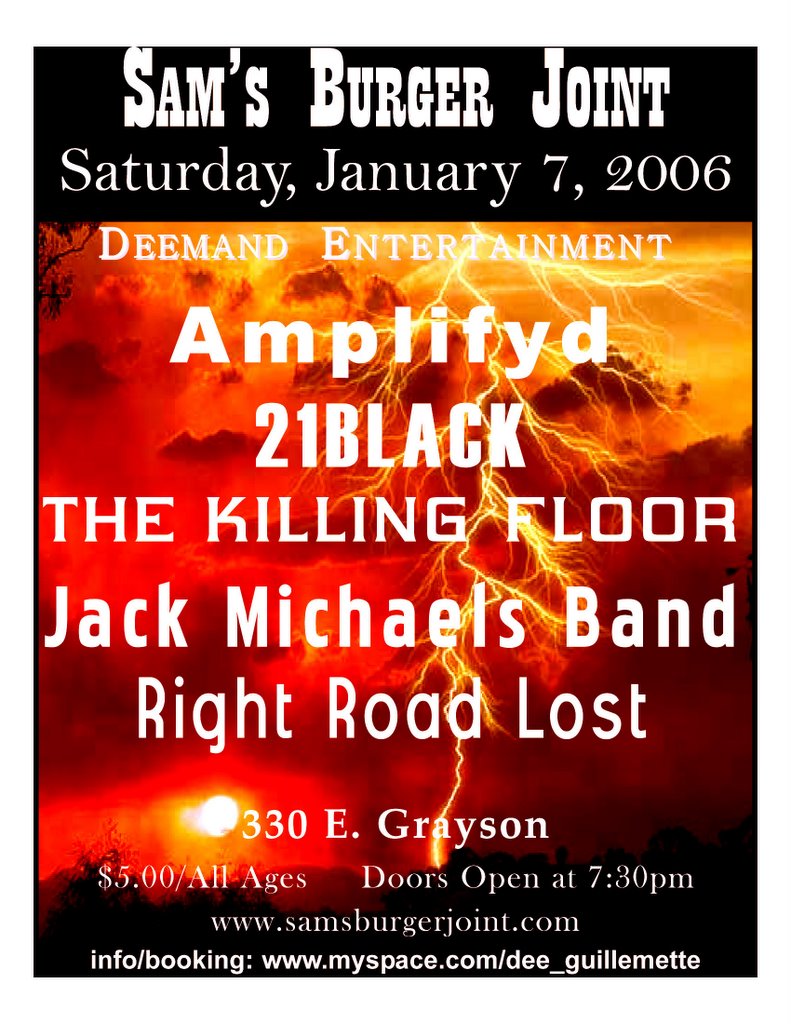
Saturday, Jan. 7 @ Sam's Burger Joint
8 - 8:45 Right Road Lost
9 - 9:45 Jack Michael Band (Austin)
10 - 10:45 The Killing Floor
11 - 11:45 21BLACK
12 - 12:45 Amplifyd

Awesome line up again!!
Doors open @ 7:30 - $5 Cover, All Ages Welcome

1.01.2006

December Stats: Top 5 Jukebox

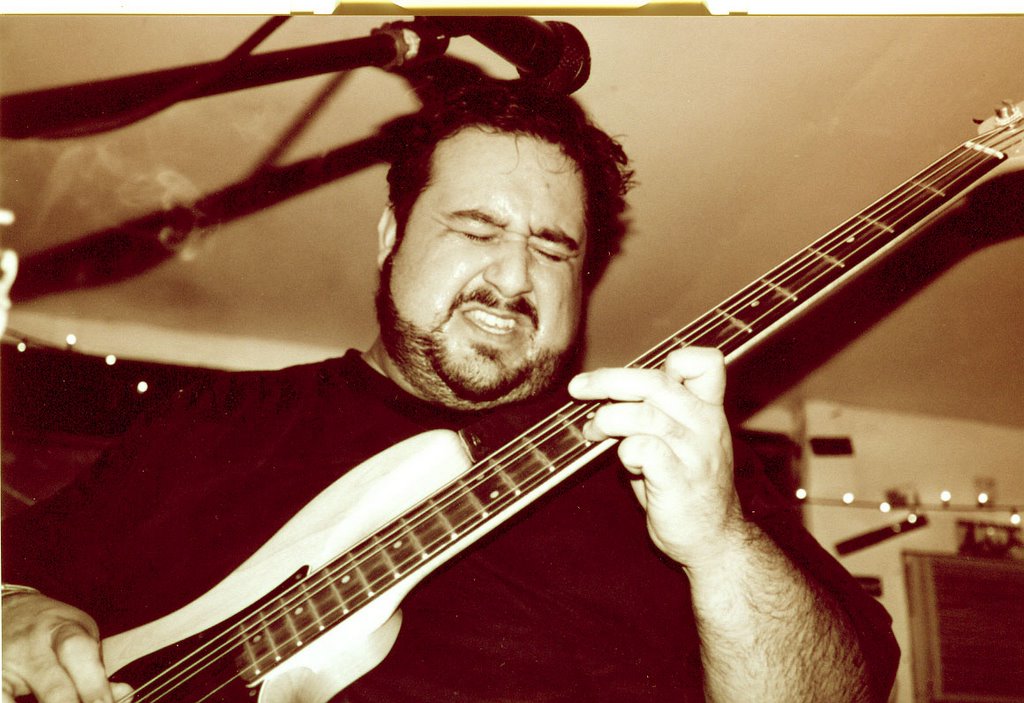
(Da Man Bass for TKF: David Garza)


Taken from SA ROCKS Blogg: Saturday, December 31, 2005

December Stats

Well, as December (and 2005) closes, here's a look at how things went in December on SA Rocks. This month was up about 1,000 hits from November. December saw around 8,500-8,800 hits. Somewhere around 5,000 people visited the site, and it looks like we're up to about 1,500 regular visitors. So we're definitely moving forward and I can't wait to see what happens in 2006! Ok, the fun stuff. For some reason I'm not getting stats on the last 6 days of December when it comes to the jukebox plays, but from the rest of the month, here are the Top 5's:

Top 5 Songs by Hits:

1. El Sancho "Mota-vation"
2. The Killing Floor "Voodoo Chile" (cover)
3. Skunkweed "Wasted"
4. Amplifyd "Sun and Moon"
5. Structure "Like I Should"

Top 5 Songs by Kilobytes:

1. The Killing Floor "Voodoo Chile" (cover)
2. 21BLACK - "Take Some Time" (cover)
3. El Sancho "Mota-vation"
4. Amplifyd "Sun and Moon"
5. Skunkweed "Wasted"

Close contenders:
Monkey Blood and Sexto Sol

And the top outside links clicked on in December: Top 5 Band Links:

1. Spastic Ink
2. Failsafe
3. Rok Candy
4. Chris Boss
5. Jawbreaker

Top 5 Club Links:

1. Q Bar
2. Atomix
3. Babcock Bar
4. Hooligan's
5. Rock City Bar

I hope SA Rocks has helped bands and clubs in 2005 in getting people out to hear all the great local music. Any comments on how/if we've helped you would be great to hear! Hope to do some new and fun things in 2006...SA Rocks parties for one thing. And I really am working on getting some CD reviews up there! Been busy, busy, busy!


Happy New Year!!
Thanks to everybody for everything!!
posted by Rowan at 8:42 PM 1 comments links to this post

12.31.2005

Interview: JCM of The Killing Floor, by Anthony Castilla

Taken from SA Rocks Blog: Tuesday, December 27, 2005

Pictures by: DJTazz, Rowan and Kel


Interview: JCM of The Killing Floor

Thanks to Anthony Castilla (of SPITFIRE) and JCM for doing this great interview!


Anthony: What made you pick up the guitar? Was it a song or artist, and how long have you been playing?

JCM: Music has been in my blood ever since I can remember… My dad is a percussionist/drummer and my mother would see my father perform during the weekends while she was pregnant, so I guess I was doomed to be a musician…I’ve been playing guitar for about 20 years and it still brings me tears of joy and frustration…

Was the guitar your first instrument of choice?

No, drums were my first instrument of choice, and I played drums during my early teens in middle and high school. My mom couldn't afford or didn't have room for a drum kit. I happen to think she couldn't handle me beating on drums 24/7, and she was also thinking of our neighbor’s sanity.


Where did the nickname "El Diablo" come from?

My parents used to call me that when they'd see the videos I used to watch on MTV's Headbanger's Ball, and my album collection didn't help either. I still get teased about AC/DC “Highway To Hell” .I do remember also way back someone mentioned to me that I play like the devil himself. I guess I should have taken that as a compliment. But the devil always loses…

But more recently Darren, a good friend of mine, is so knowledgeable in everything from music to history from any era, time and just anything, I stuck that name on him… But I think Darren is Cartaphilus, too much knowledge for one man is kinda scary and plus he doesn't age…lol!

I might be speaking out of turn but I think we both come from the hard rock to metal to shredder era, when players like Yngwie and the Racer X type guys came out did you automatically say, "I have do this stuff"?…

Yeah I did… I am guilty of coming from that kind of schooling. I was in my mid to late teens and it was great and healthy in a sense of discipline to strive to be a virtuoso. It took so many hours of my teenage life that I missed my high school's prom and a teenage social life too. I basically became a hermit, recluse for a while…lol

I was guilty of that but learned how to write songs instead practicing from sun up to sun down-haha. I found Jimmy Page and the Edge from U2 to be my turning points after the shredder era, but it helped my dexterity out practicing a lot, how about you?

I still noodle every now and then with picking, three-notes per-string runs, hammer-on and pull-offs, and legato licks, and blah, blah, blah, exercises. But I see that as just that - exercises. When I pick up a guitar now, it’s more of a writing process on how I feel that day or trying to experiment on different compositional things. But when I get bored, then theory or combining different scale exercises to get out of a rut of sounding the same always seems to work. My goals are to create without thinking, to be spontaneous without prediction as an entertainer, writer, singer, and guitarist. I still have to work very hard in all four areas to keep proficiency. As far as performing I just let it flow but most important to me is to be musical and entertaining.

I feel that the shredder era was the best because thereafter it got really boring. If it wasn't strumming at 120 miles an hour, reckless, sloppy or d-tuned to B-flat then you weren't cool. Now I understand that trends come and go, but there has to be a balance too and I've never let radio decide for me what was in or out. I love to listen to Nirvana and Steve Vai, then maybe Dream Theater to Freddie King and not have a problem with any styles or era of music. There’s a band that I heard on the radio, Avenged Sevenfold, that I was totally blown away. So I think guitar solos are coming back. But it will come back different as trends usually do.


I notice you play bluesy rich stuff nowadays. Since when and why?

Texas, Chicago and all style blues I've been always into… In the radio waves back in the ‘80’s were SRV, Jeff Healey, and Eric Gales to name a few and then early ‘90’s came Ian Moore, Kenny Wayne Shepherd and Johnny Lang. At that point in time I had made up my mind that I had to learn to sing and be a front man if I was to create and express my own material in my own way. Till this day it’s been the hardest thing I've ever had to learn to do and I'm still learning. To sing and play guitar at the same time without losing the in sync thing was the first challenge. Then writing lyrics and coming up with original material and then presenting them in front of an audience was the next.

Blues and true Alt Rock/Blues Rock (not industry-labeled alternative rock) seems to have lost its place in this overprocessed sounding music these days. What would you like to change about this? Or would you change anything?

There soo much talent out there that will never see the light of day on radio because it doesn't sound like today’s trends. I think that is really sad. It’s not like that in Europe, Japan and other countries. There are a couple of friends of mine that have been asked to tour Europe because they are still well known and received but that's not the case here.

I would love to see a radio station that would play signed, unsigned, unknown, local and regional acts. But that would be a big risk and I know it’s all about paying the bills. .There are other ways to promote and spread your music. Internet sites like this one and public access TV shows and college radio stations do the underground and local music scene a big service and justice. So with that being said… Thank God for the internet sites and public access TV shows that promote local music. You talk about a labor of love that we, the music scene, need to help, support, sponsor and show the love right back.

What is next for your band The Killing Floor?

We are going to the studio in mid to late February and hopefully a release by March ’06. We have a couple of gigs lined up in January 2006..

Sam’s Burger Joint Jan. 7th.

The Rox Room on Jan. 27th.


Your personal performance live with TKF is something to be seen. I hear you take cell phones and make your guitar talk and have sex with it, do you just go for it?

LOL having sex with my guitar?? It was safe sex btw… The guitar was plugged but I wasn't stepping barefoot on a puddle of water. Anyway all kidding aside, it's just a moment thing that I get into the zone and I'm proud to say that not all of The Killing Floor’s performances are ever the same good or bad. I do have bad nights too. There's something about being spontaneous. It's kinda like flirting with danger that can sometimes backfire and trust me it has…

What would be a dream gig for you?

mmm… I wish my bro Anthony Castilla, from Spitfire, would come and see a Killing Floor show. That would be the first one… Yep I put you on the spot now, lol! It’s all brotherly love.

What was your best and worst show?

The best: A gig at Broadway 50/50 and meeting one of the drummers from Toto and his compliments on us not to change our sound and to keep doing our thing. Rick Sanford, of Legs Diamond, as a special guest for The Killing Floor and doing six tunes with us was the next.

Now the worst… There were quite a few of those too…lol!

Let me see… A gig in College Station… The drive back almost killed us… We were all dead/beat tired and we had to wait until 2:00am to get paid. Then the four hour drive back to SA was so grueling. I remember being very sleepy to the point of passing out while driving on the highway and it was freaking cold too…

But the worst was an Austin booking gig that failed to happen. What was strange was five days before the gig our cars were breaking down and we counted fifteen different bad things happening to all of us that would prevent us from not making to Austin. Up until the day we had to leave we were still having problems. When we finally made it, they cancelled the whole show because of lack of promotion. Then to add salt to injury we landed a last minute plug and play gig a few streets down and then David’s bass amp takes a shit and fries on the third song. What a nightmare and after that happened... I felt I was in the Twilight Zone...

What bands have you been in since you have been playing guitar or bass?

I played bass for Double Clutch and I just recently quit. I play guitar and do oldies but goodies for The Psychedelic Jukebox w/ Mark Carrillo and of course I sing and play guitar for The Killing Floor.


What guitar player or guitar players Alive or Dead would you like to trade notes with? Like a Jam session vibe?

Oh man… Jimi Hendrix, SRV, Eric Clapton, Eric Gales, Ian Moore, too many to list here… I think Jimi would be my first choice.

Steve Vai too… But I would need a week to get my chops up to par. So hermit, recluse state here I go again and let's relearn all the bags of tricks of shredding licks. I would also have to dust off my Ibanez RGs and get used to playing 9-46 strings again too... Shit life can never be that simple right…lol.

Where can we get more info on you ( what website)? Where can we buy your CD’s?

http://www.thekillingfloor.net

www.myspace.com/thekillingfloor

http://www.thejcmexperience.blogspot.com


What advice would you give a new guitar player starting out?

Nothing in what you are learning or doing is in vain. But you have to keep proficient and always reinvent yourself, for nothing worth having is ever easy. Play from your heart and let your mind guide you and don't let anyone tell you otherwise. Always record yourself for there’s nothing more humbling than hearing the playback, and listen. Listening is the key to your answers.

You're stuck in a Biodome for one year. What gear would you take with you?

For one year??… That's an easy one.. Give me an acoustic steel string guitar, a box of compositional notebooks and blue Papermate pens, and twenty packs of GHS 11-50 guitar strings (I break a lot of strings), and I'm ready… Now take me to your leader…lol!

JCM thank you for your time. You rock, brother.…

Thank you Anthony and Rowan of SA Rocks…


posted by Rowan at 9:39 PM

3 Comments:


Anthony C said...
Thanks for the Interview. JCM is way to
cool ! Keep em coming guys I dont have anyone for next months guitar Interview.
so far Ron Jarzombek and JCM -you could be nextif you think you have an
interesting story let me know.
4:05PM

Anonymous said... Anthony you're tha man!!! JCM 2:07 AM

Anonymous said... no sir! your the man! I can't mess with the Devil. I am saying this in that Whataburger dudes voice. (( whataburger! hheheheheHave a bad ass new years bro! 7:59AM

Archer Ave, The Killing Floor and Amplifyd: Nov.06,2005


Picture and reviews were taken from SA Rocks: Sunday, November 06, 2005

Archer Avenue Live


As I mentioned in the recent interview with Archer Avenue, I’ve been in contact with these guys almost since the beginning of SA Rocks. At that time they were in Burbank recording at Dog Bone Studios and not out touring, so I’ve been waiting a long time to catch them live. I finally got my chance Friday night at Rock City Bar with The Killing Floor and Amplifyd. (I swear I’m not following TKF and Amplifyd around! They just keep playing with bands I want to go see!) It was well worth the wait.


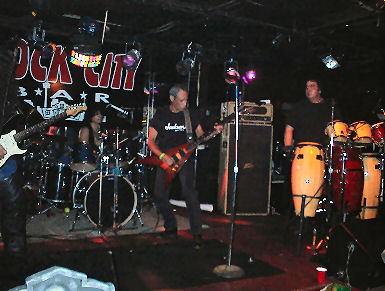
Archer AvenueArcher Avenue is not really much of a “show band,” they don’t run and jump around or tell stories between songs or any of that sort of thing. They’re pretty much all about the music. And the music is good. When I interviewed them, I mentioned that their music reminds me of the popular alternative rock of the late 90's and Marc said, “In the end it comes out sounding that way, but I think we are all going for different sounds and styles, and for some reason it comes out sounding like late 90's pop.” Evidently that’s true, because one of the first things Staci said was, “I like them. They remind me of the Gin Blossoms.”


Archer Avenue

They played several songs off of their upcoming CD, We Watched the Headlights, We Watched the Stars, including “Breakdown on N. St. Mary’s,” “She is America,” and “The Most Permanent Tattoo,” as well as previous material such as “Marty Robbins” (which you can listen to on the mp3 jukebox above), and a great cover of “You’re Gonna Miss Me” by 13th Floor Elevators. Great guitar on that one!I don’t know when Archer Avenue will be back in San Antonio. They have some dates coming up in December in El Paso and New Mexico and are working on booking a southwest winter tour in anticipation of their upcoming album, which I believe is due out in January. Check Archer Avenue’s website for updates. You can also catch them in an interview with “The Scene” Tuesday, November 8th, at 12:30 AM on Time Warner Cable Channel 20.

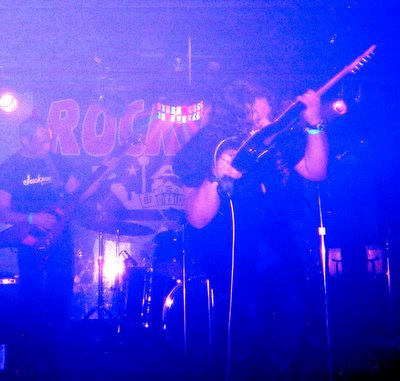
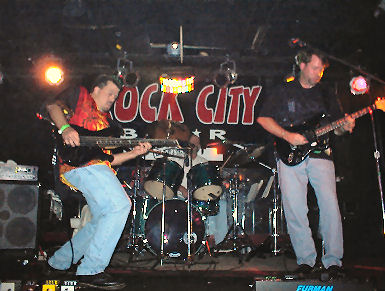
The Killing FloorThe Killing Floor was up next and this was a little different than their usual show because their bass player, Matt, was out of town and they had Tommy T filling in, so they couldn’t do any of their original songs. But, hey, nothing wrong with a set of blues rock favorites like “Voodoo Chile,” “Hey Joe” and “Cold Shot.” Tommy T gets almost as crazy with his bass as JCM does with his guitar, so it was quite a show. At one point, they both had their guitars on the floor, JCM playing with his foot and Tommy bouncing his bass up and down.

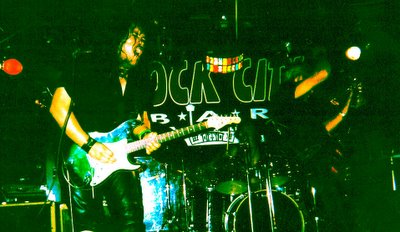
My favorite part was when Garbage walked by and handed JCM a cordless phone, and without breaking stride at all, JCM grabbed the phone and started playing his guitar with it.
JCM with the Phone.


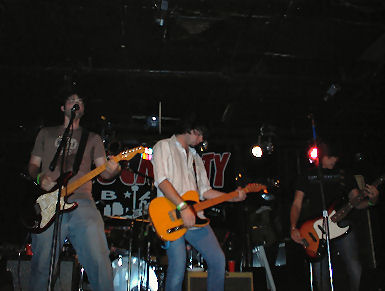
Last up was Amplifyd, sounding great as usual, playing their originals like “No More Pain,” “Sun and Moon” (also on the jukebox as well as TKF doing “Voodoo Chile”), “Lies” and “Waitin’ for You,” as well as songs by KISS, AC/DC and ZZ Top.


AmplifydAnother great show at Rock City Bar!!
posted by Rowan at 4:48 PM

2 Comments:
jcmexperience
said...
The Killing Floor feels so lucky in playing and meeting with great
acts this year 2005... My thanks to Rick Sanford, Ese, Vatos Locos, Archer Ave,
Lay Moes, Double Clutch, Veveteen Skeen, SpitFire, St James Infirmary, SA
Creeper, and our brothers from Amplifyd, Rock City and of course SA Rocks. Next
year will be an explosive year for the San Antonio music scene and I know I'll
be reading it here first on SA Rocks!! JCM
7:05
AM

Anthony - SpitFire said...
Do it Carlos do it!Cell phone ?
can you hear me Now !?Good!